
Ai vis pacem, para bellum. [Lat.] If you want peace, prepare for war.
Credent Star, Inc. most certainly does not advocate war, economic or otherwise. However, given the state of America’s economy; the increasingly obvious economic, political and social intentions of the current regime in Washington; and the paralysis extant in Congress; we do strongly recommend firm and clear-eyed economic analysis and preparation within the realms advocated by two trusted Latin concepts: Veritas and Aequitas. This section is designed to help executives of potential client organizations assess their current and future needs for Credent Star, Inc. services by assessing the lessons to be learned from recent hard economic, social and political data.
Veritas. [Lat.] Truth.
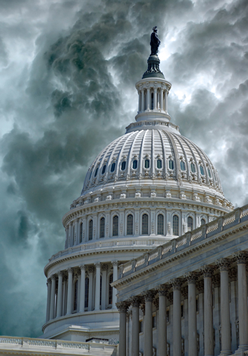 According to a recent report by the bi-partisan United States Competitiveness Project, over the past decade and relative to other advanced economies, America has undergone a markedly deteriorating position in such crucial business operating parameters as availability of skilled labor; flexibility in hiring and firing; frequency of illegitimate employee lawsuits; available logistics and communications infrastructures; growth of governmental regulations at the local, state and federal levels; failure of unionized K-12 education; deterioration of business-friendly legal structures, economic frameworks and tax policies; and faith in the existing political system to fix what’s wrong, and the mainstream media to report it fairly.
In essence, over the past decade necessary business skills have eroded, unnecessary costs have erupted, critical assets have been wasted on both the micro- and macroscale, and for-profits and non-profits both secular and Christian have accordingly incurred substantial cost increases in operational sectors such as employee health care, payroll and pensions, legal and accounting, utilities, insurance, and many additional supply and operational sectors across the board. And that is not counting the nation’s massive and growing debt, or the long-term impact of a negotiated political compromise that fails to decrease spending and debt, reduce burdensome governmental regulations, increase both business and personal investment and savings, balance the federal budget, and set the nation on a truly sustainable fiscal path. This also comes at a time when the federal government attempts to force healthcare mandates regarding contraception, sterilization and abortion on faith-affiliated hospitals, universities and charities that abrogates personal religious beliefs and organizational religious freedoms, via the levying of crippling Internal Revenue Service fines that may ultimately force many such Politically Incorrect entities to close their doors forever. Not to mention the chilling prospect of the federal government preying on its own citizens, as currently demonstrated by the apparently politically motivated scandals involving the Internal Revenue Service and the Department of Justice et al.
Aequitas. [Lat.] Justice.
 Given the above data, there is true justice, and then there is the rough justice of the law of unintended consequences of the good intentions that are said to pave the road to hell. In February 2013, the Congressional Budget Office released revised baseline statistical predictions for the next decade on. America’s current gross federal debt is near $17 trillion: more than 100% of Gross Domestic Product, and is anticipated to grow to approximately $26 trillion by 2023. Without desperately-needed structural reforms, America’s already massive healthcare entitlements will grow to 9% of Gross Domestic Product by 2033. What’s worse, these health entitlements are expected to grow faster than the economy for decades to come, up to 12% of GDP by 2053 and 15% of GDP by 2073, requiring an economically-unsustainable series of never-ending tax increases.
Complicating efforts to grow the national economy beyond these dismal figures is a massive federal bureaucratic culture. The Washington Times recently noted that the United States now has over one million federal regulations, and the government bible Code of Federal Regulations (CFR) is now more than 175,000 pages long and spread over 238 volumes. This insanity is best exemplified by the Dodd-Frank bill and its more than 400 subsidiary regulations, and by the Affordable Care Act, otherwise known as Obamacare, and its over 20,000 pages of regulatory requirements that went largely unread before Congress passed the Act, and then discovered the fiscally unpalatable truth. By way of further example is the more than 140,000 individual codes the federal government requires doctors and hospitals to utilize for Medicare and Medicaid reimbursement, including separate regulations for either being “hit” or “bit” by a turtle. And if the turtle is registered as an endangered species, the red tape grows exponentially. The Competitive Enterprise Institute recently calculated that the cost of this federal regulatory leviathan is roughly $1.8 trillion annually, or approximately 11 percent of America’s Gross Domestic Product. As The Economist magazine recently noted, in response to those skyrocketing costs, America’s tax code has practically tripled in size over the past ten years to 3.8 million words, and “most of these words are in Klingon.”
 The world at large is noticing America’s plight as well. The World Economic Forum now finds the United States has only the world’s 7th healthiest economy out of 144 industrial nations. A fact that in itself does not seem particularly detrimental, until one learns that America last held 1st place in 2009, and has been steadily dropping in rank ever since. The WEF ranks our infrastructure at 14th, both education and healthcare at 34th, and, largely due to our national debt, our crucially important macroeconomic environment at 111th.
Unnervingly, America’s grim economic future may well be exacerbated by the unwitting failures of its own citizens. In educational rankings that compare student achievement in 65 advanced countries, American children recently ranked 17th in reading, 23rd in science, and 31st in math. This is already creating a vocational backlash of potentially epic proportions. A 2012 survey by the noted consultancy firm McKinsey discovered that while 87% of educational institutions believed they had well prepared their graduates for the workforce, only 49% of employers agreed. A similar survey by Deloitte found that 67% of American industrial firms had difficulty finding qualified potential employees despite the nation’s high unemployment rate, and that 5% of their positions remain
 unfilled due to a lack of suitable applicants. And numerous business reports have bemoaned the fact that the current generation of first-time employees are evidently far more interested in the rights that come with their jobs than the responsibilities of their employment. Perks and benefits that once only came with proven performance are now expected with starting positions, and the fabled corner office is often deemed a right rather than a reward for a track-record of success.
Ne cede malis. [Lat.] Yield not to misfortune.
While the above litany of woes reflect national macroeconomic concerns, obviously the microeconomic issues of our individual clients are what most concern Credent Star, Inc. Yet, given the macro issues extant and growing, it is wise to be prepared for every single microeconomic eventuality. As previously stated, in this day and age, every dollar saved is indeed a dollar earned. And at $150,000 to $500,000 in net savings, representing 15% to 40% reductions in annual operating budgets, even if a GPO analysis was conducted a mere six months previously, Credent Star, Inc. helps prepare our clients for an economic future that is almost certainly going to get far worse before it gets any better.
“Don’t let anyone lead you astray with empty philosophy and high-sounding nonsense that come from human thinking and from the evil powers of this world, and not from Christ. For in Christ the fullness of God lives in the human body, and you are complete through your union with Christ. He is the Lord over every ruler and authority in the universe.” Colossians 2:8-10.