
Quo vadis. [Lat.] Where are you going?
The Lessons of Educational Infrastructure
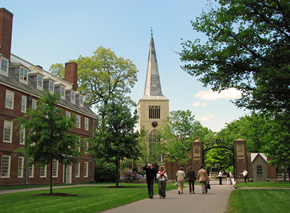 America’s “educational-industrial complex,” the massive bricks and mortar facilities from large urban public school districts, to small rural districts and private schools, to the nation’s public and private two- and four-year colleges and universities are, in economically-absolute terms, an operational infrastructure not unlike our nation’s power grid, railway system and roads. Like all infrastructures, education creates jobs and both organizational and individual revenue streams, investment and business opportunities, laws, rules, regulations and industry operating standards. In short, as our society has become financially dependent upon its existence, our education infrastructure has created both economic stability and a working testament to our values as a society.
However, our educational infrastructure, like all physical infrastructures, operates in a capitalist environment predicated on creative destruction. This economic concept is most often expressed through technology, as when a new product of service completely eliminates an entire existing product or service sector. Consider how the invention of the refrigerator ended the reign of not just the home ice box, but the entire ice house industry. Or how the growth of Big Box retail chains and nationally franchised fast food restaurants impacted small neighborhood retail entities and dining establishments. When was the last time you saw a once ubiquitous public telephone, and what changes has the now equally ubiquitous cell phone wrought in your life? In that light, disruptive technologies and financial consequences of past regulatory strategies are now emerging to challenge the educational infrastructure, and like so many economic sectors before it, the educational infrastructure is finding that it must adapt or die.
Creative Destruction and Disruptive Technologies
Historically, our educational infrastructure was based on the premise that knowledge was a rare commodity that could only be controlled by the infrastructure itself. Thus educational courses, physical facilities, choice and availability of instructors, and financial considerations favored the school at the expense of the student. However, with the rise of the Internet the educational paradigm began to shift the focus from the infrastructure to the student, with startling results. The culprits are MOOCs, or Massive Open Online Courses, that are already negatively impacting the traditional educational-industrial complex. The Economist recently observed that, “University brands built in some cases over centuries have been forced to contemplate the possibility that information technology will rapidly make their existing business model obsolete…in which cheap online providers radically reduce the cost of higher education and drive many traditional institutions to the wall.” Echoing that warning, the DaVinci Institute recently noted, “The education industrial complex is perhaps the most influential in the world, with everyone from Presidents and world leaders, to Nobel Laureates, to CEOs and business executives all unwavering in their support of colleges and their accomplishments. So what happens when the legacy power of an institution meets a rapidly changing business environment driven by emerging technology? Some will survive, but many will not. Ironically, we are entering into a period where the demand for education will rise substantially. Yet traditional colleges are such a mismatch for what future consumers will want that dropping enrollments will cause many to fail.” The DaVinci Institute also noted that the first of eight core issues driving this failure are high college overhead costs such as utilities, payroll, insurance, phone systems, security, maintenance, and the rising cost of the bonds and other financing instruments universities use to cover inevitable revenue inconsistencies.
 The foundational data of this rapidly growing MOOC impact is irrefutable. In April 2013, the DaVinci Institute released the latest impressive statistics for open online colleges. EdX, a non-profit begun by Harvard University and the Massachusetts Institute of Technology in March 2012, already has over 700,000 students at select schools. Coursera, a competing online educational delivery platform created in April 2012 and currently utilized by only 83 colleges, already has 2.8 million students registered for web-based classes. Apple Computers, through its downloadable iTunes U platform, has surpassed one billion downloads, and Stanford University alone has counted over 60 million iTune U downloads. And the Khan Academy is boasting 242 million global downloads through its Canvas and Udacity platforms. Assisting this growth is a growing acceptance of online education by employers. In 2011, Excelsior College and Zogby conducted a nationwide survey of employers and discovered that nearly two-thirds found online courses as credible as traditional courses. This rapid, large-scale shift to employer-acceptable online learning is anticipated to impact the future educational decisions of an entire generation of students. Particularly as the burdens of the recession of 2008 continue to negatively impact people’s lives, relative incomes, and educational choices.
Creative Destruction and Sacred Cows
 Also impacting those future educational decisions of an entire generation are the financial ramifications of the federal student loan program. The Federal Reserve recently calculated that over 35 million America citizens currently owe in excess of $1 trillion in student loans. Unfortunately, 11% of these student loan repayments are 90 or more days behind, a rate that now exceeds that of domestic credit card debt. And Fed researchers have found that those delinquency figures are also largely understated, because student loan repayment is not required while the borrower is still in school, and many graduated borrowers have been granted a temporary postponement due to financial hardship. Moody’s financial consulting firm recently warned of a wave of future student loan defaults that are anticipated to have a wide-ranging and crippling economic impact on the country, and predicted that tightening the student loan system to avoid future defaults may actually force many small private colleges out of business.
The government’s goal was the sacred cow of making student loans available to as many people as possible, largely irrespective of their ability to earn a degree, or find suitable employment after graduation and pay back the loans. The end result of not killing the educational sacred cow is a federal loan program that has saddled millions of Americans with loans they will never be able to repay, has families drowning in debt that they are legally unable to discharge in bankruptcy and that will haunt their consumer credit worthiness for years. Not to mention yet another tax burden placed on the American people only a few years after aggressive mortgage lending, predicated on a similar sacred cow of home ownership for everyone irrespective of their ability to repay their home loans, triggered a financial crisis from which the nation has yet to recover.
Creative Destruction and the Rock Star Response
 In a curiously literal infrastructure response, many colleges and universities are now competing to see which can offer students the must luxurious educational experience. Amenities now being unveiled across America include student residence halls boasting granite countertops, hot tubs and walk-in tanning booths, “relaxation rooms” with professional-grade aquariums, big-screen HD televisions and “napping pods,” professional quality gyms with climbing walls and bouldering caves, and lavish landscaping complete with artistic fountains. Yet with the 2008 recession, private financial gifts to universities declined dramatically while facility construction increased. Between 2010 and 2012, colleges and universities spent $22 billion on these new facilities, or twice the amount they spent a decade earlier. Of course, these additional educational expenses are passed on to the students who, of course, respond by taking out larger student loans. A double-edged sword of an absurdly lavish educational experience helping foster an entitlement mindset that, combined with the current economy, actually conspires to hurt the employment efforts of new graduates. The Human Resources Policy Association recently released a report stating that over the past three years, one in five new graduates have displayed behaviors that actually cost them jobs, including taking cell phone calls or texting during job interviews or early employment meetings, bringing pets to interviews or work, and even bringing their parents to employment interviews. Fully 48.6% of HR executives feel recent college graduates fail to exhibit professionalism in the workplace, 44.6% report a worsening of new employee work ethic, and 52.9% report a disruptive sense of entitlement among new employees.
Docendo discimus. [Lat.] We learn by teaching.
The U.S. Department of Education recently announced that the average tuition at a four-year public university climbed 15% from 2008 to 2012, while scholarships at similar institutions dropped 10% from 2001 to 2012. In 2012 this shifted 29% of students to two-year community colleges versus 21% in 2010, and 51% of college students were living at home in 2012 versus 43% in 2010. And in many cases, those students have joined the 23% of recent college graduates returning home after graduation due to their inability to find employment. The unemployment rate for the 18 to 29 age range is now at 12%, or twice the national average. And worse yet, a recent study by the Heldrich Center for Workforce Development found that 43% of recent graduates who actually found employment are working at jobs that do not require a college education. In short, the lynchpin promise of the “American Dream” that higher education invariably leads to a better life has been found by millions to be a complete falsehood. In that light, both National Public Radio and Newsweek recently referred to the nation’s millennial generation as the “screwed generation.”
 While Credent Star, Inc. can do absolutely nothing about the above-noted disruptive technologies, voracious sacred cows, rock star educational environments, and dim employment prospects of an entire generation of American citizens, we can nonetheless reasonably predict the disturbing outcome of the collision course with economic reality that America is now set upon. And in so doing, thereby assist our clients to survive these unavoidable elements of creative destruction largely intact. By helping our clients to achieve 15% to 40% savings in annual operating budgets by earning gross savings of $150,000 to $500,000, even if a similar GPO analysis was completed only six months prior, Credent Star, Inc. puts profit back into our client’s banking accounts when they most need it.
“We are pressed on every side by troubles, but we are not crushed and broken. We are perplexed , but we don’t give up and quit. We are hunted down, but God never abandons us. We get knocked down, but we get up again and keep going. Through suffering, these bodies of ours constantly share in the death of Jesus so that the life of Jesus may also be seen in our bodies.” Corinthians 4:8-10.